Home / Planning permission
Free checkerDo I need planning permission for a driveway?
Most people don't — but almost everyone gets the rule wrong, especially when they're replacing an existing drive. Answer six questions and find out.
The actual rule
There's only one thing that triggers it
Under Class F of the GPDO 2015, a front driveway needs planning permission in one situation, and one only — when all three of these are true:
- It’s on the land between the front wall of your house and a highway (a road or a public footpath).
- The new — or replaced — hard surface is more than 5 square metres.
- It’s an impermeable surface and the water runs off onto the road rather than soaking away on your own land.
Break the chain anywhere — go porous, drain it to a border or soakaway, or keep it under 5m² — and it's permitted development. No application, no fee.
The bit everyone gets wrong
Replacing an existing drive counts too
Nearly everyone assumes that re-laying a driveway that's already there is automatically fine. It isn't. The legislation covers “the replacement in whole or in part of such a surface”, and the 5m² test expressly counts “the area of hard surface replaced”.
So ripping out a tired concrete drive and laying new impermeable block paving that still drains to the road needs planning permission — even though there was a drive there for thirty years. It's the most common way homeowners end up with unauthorised development on their hands.
What actually counts as porous?
The government guidance names these: gravel or shingle, reinforced grass and gravel, porous asphalt, porous concrete blocks, and permeable block paving — laid over an open-graded sub-base (not the usual MOT Type 1, which stops water getting through).
Treated as impermeable: ordinary concrete, tarmac and standard block paving.
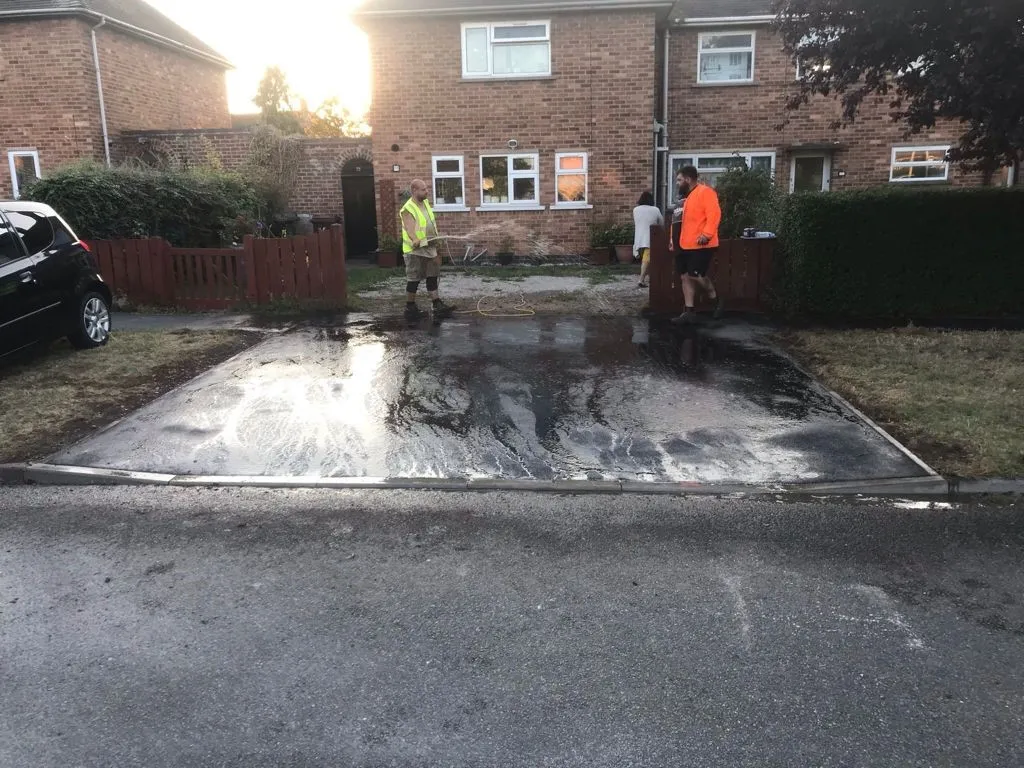
There's a practical test in the guidance: run a hosepipe on the finished surface for a minute or two — there should be no puddles, and the water shouldn't run across the surface more than about 200–300mm before soaking in.
Where resin fits — honestly
The guidance was written in 2008 and doesn't mention resin at all. Anyone telling you “resin is always exempt” is stating something no official source says. What the law actually asks is a functional question: does water get through, and where does it go?
- Resin-bound (stone mixed through the resin) is porous if it’s laid on a permeable base. Lay the same product over an old sealed concrete slab and the water has nowhere to go — so it fails the test.
- Resin-bonded (resin painted on, stone scattered over the top) is a sealed coating on a solid base — treat it as impermeable.
That bound-vs-bonded distinction is industry practice rather than statute — which is exactly why we build the base to suit. See resin driveways.
Planning permission and a dropped kerb are two different things
This trips people up constantly. They're separate consents, from different departments, and you can need one, both, or neither:
Planning permission
From your district council. Only needed in the cases above — or if the access is onto a classified road. Most driveways never need it.
Section 184 licence
From the highway authority. Needed for every new dropped kerb, always, no exceptions — it's work on public highway. We handle this one.
One catch worth knowing: if the driveway itself needs planning permission, the new access can't fall back on permitted development either — so both end up in the same application.
If you'd rather drain it than pave it porous
Directing run-off to a lawn, border, rain garden or soakaway on your own land keeps you permitted development at any size. A few things the guidance is firm about:
- Keep a soakaway at least 3m from building foundations — more if the ground’s poor.
- Heavy clay soil often won’t soak away fast enough; you may need a pipe to the roof drains instead.
- On a drive steeper than about 1 in 20, permeable surfacing may not be suitable — drain it instead.
- Never direct water onto a neighbour’s property.
We design the levels and drainage as part of the job — see driveway drainage.
Where this comes from
Everything on this page is taken from the legislation and official guidance — no rules of thumb. Last checked July 2026.
- GPDO 2015, Sch.2 Pt.1 Class F — the 5m² / porous / drainage rule
- GPDO 2015, Sch.2 Pt.2 Class B — access onto a classified road
- GOV.UK — permeable surfacing of front gardens — surfaces, soakaways, the hosepipe test
- Highways Act 1980, s.184 — the dropped kerb licence
- Planning Portal — dropped kerbs
This is a guide, not legal advice — if you're on the line, your district council's planning team will confirm in writing.
Want us to just sort it?
We'll tell you straight whether you need permission — and handle the dropped kerb application either way.